Meteorology 1010 Project 2
Wind and Home Ownership

Many decisions go into the laborious purchase that is known as home ownership; many customers consider, the square footage, number of bedrooms, bathrooms, size of the back yard and so on. Among the many considerations, one quality seems to ring true in every case, location, location, location. This can be in many contexts, including the proximity to work, safety; but what often gets left out is, what are the weather effects in the area? The one area I really want to hone in on is the wind patterns across the state of Utah with regard to home purchases. We hear how, “South Jordan is nice but is sure is windy!” comments all of the time, but is there data to really support this? It may be surprising what the data might show.
When I first began researching this project, I wanted to come up with something creative that helped not only me, but others in a practical sense. I have lived in two areas of the Salt Lake valley and hope to use that experience in this paper. I grew up in the heart of downtown Salt Lake, on the west side of Capitol Hill. This is a quiet neighborhood, older, developed mainly by Mormon pioneers near the turn of the 1900’s. I now live on the east bench of the valley, in what is known as Sandy. While wind is a natural part of our atmospheric environment, and the natural propeller for clouds, storms, and pressure to move through, our cities residents are not all treated as equals. The following maps will help explain this point.
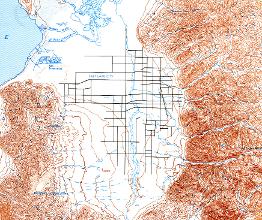
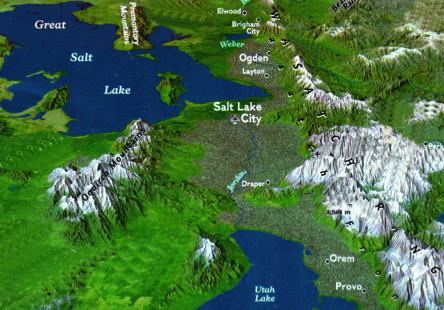
In looking at the map below, we can easily identify that the wind responsible in the Salt Lake valley is primarily based on the topography of the land. Salt Lake county is a bowl, with the east bench rising to the east and an eventual rise to the west once you hit the Oquirrh mountains. As you analyze the chart, do you see a path of least resistance? Looking toward the west and southwestern part of the valley, you see a natural channel coming from the north where the Great Salt Lake connects with I-80W. While wind or storms do not ‘naturally’ follow this entrance on their way to the Wasatch Front, they will typically use the channel of this low and flat area of the valley to create some reportable wind gusts.
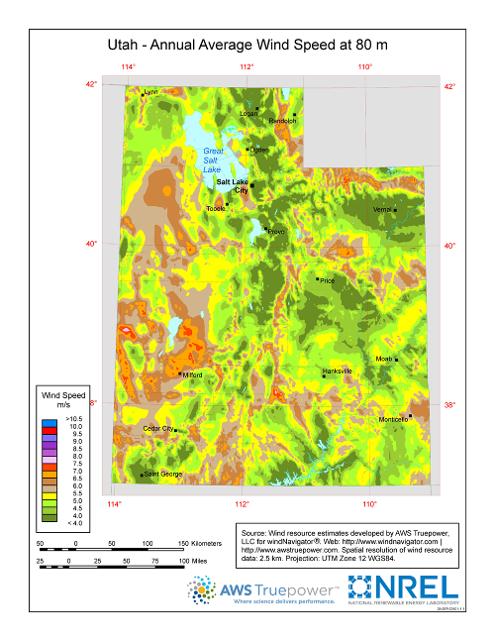
To use the data from the, US Department of Energy, which was originally used to evaluate the ‘state’s potential wind capacity from a development, policy, and a job and economic development impact perspective’ can also tell us which regions home owners should be made aware of. In further detail, we can see that much of the Magna, West Valley, West Jordan, South Jordan, Riverton, and Herriman communities are generating natural wind approximately 6 m/s as a whole. Going from there, we see a more concentrated force in the central part of the valley generating upwards of 6.5 m/s and in some parts of West Valley and Magna, getting close to a whopping 7.0 m/s of wind. The US Department of Energy considers regions with a wind speed of 6.5 meters per second or more are ‘generally considered to have a resource suitable for wind development’.
The Department of Energy went on to assess the wind level at other height measurements to determine whether Utah would be sustainable to install wind generating equipment. The charts showed much of the same data as reported above (shown below) that the central Salt Lake Valley generates much of the wind experienced in the county. Now why would this be important do you ask? Wind is something that gets old – fast. Homes are designed to let air in and out, so that we can have fresh air to breathe, with that said, gusts of air coming in and out of vents, blowing furniture and other possessions across the back lawn can be not only annoying but damaging over time. Wind will often cause older rooftops to come apart, exposing a high cost repair. The excess costs do not end there, wind causes an excess dry out of vegetation which leads to a higher water consumption. In a popular gardening column, Gardening Know How, Nikki Phipps explains the damage wind can have to plants, ‘Wind affects the growth and development of plants in many ways. Shorter growth and abnormal development results from excessive movement caused by wind. This is a common occurrence seen in plants grown in windy areas.’
While the monetary consequences might not be so bad and can be dealt with, there is a health risk associated with living in these conditions, in the form of excess dust inhalation. On the United States Environmental Protection Agency webpage, many of the health risks are widely accepted and published as common risks for most everyone, not only the young and the old. They go on to state that ‘exposure to such particles can affect your lungs and heart’. The most common symptoms of such an environment include impaired respiratory capacity, asthma, coughing, irregular heartbeats and lung disease to name a few.
In conclusion, I think that where you choose to become a homeowner should take lots of research, in many different areas. While proximity to work and the convenience store are all attractive aspects in choosing a location, our health and home life must also be considered with how the weather effects that geography. Wind is Salt Lake City’s biggest enemy and friend. Throughout the year we all benefit that it will move fresh air through and give us the clean air we strive for, but the residents of the west side of the Salt Lake valley are getting a little more. Taking the proper precautions to ensure air filters are regularly replaced and finding creative ways to landscape our yards so we are not overusing water to accommodate for the moisture deprived plants are all ways to live in a windy environment. Above all, keeping our health should be our top priority.
*Much of this information is speculation based on the data I read as there was not much information specifically on this topic.

Health. (2016, February 23). Retrieved April 30, 2016, from https://www3.epa.gov/pm/health.html
Phipps, N. (2009). Wind Resistant Plants For Your Windy Garden - Gardening Know How. Retrieved April 28, 2016, from http://www.gardeningknowhow.com/special/spaces/wind-resistant-plants-for-your-windy-garden.htm
Utah Wind Resource Map and Potential Wind Capacity. (n.d.). Retrieved May 01, 2016, from http://apps2.eere.energy.gov/wind/windexchange/wind_resource_maps.asp?stateab=ut